How a Surat Saree Is Actually Made — From Loom to Fall-Pico
A retailer in Kuala Lumpur who has moved Surat sarees for a decade once admitted to us that she did not know what a jacquard head does. There is no shame in that gap. Plenty of people sell this product without ever seeing one made, and the ones who learn the process negotiate better, quality-check better and reorder smarter.
It Starts as Filament, Not as Silk
Surat saree manufacturing begins upstream of the loom, in the city's texturising halls. Polyester filament arrives on beams from the petrochemical complex at Hazira, gets texturised into the crimped, workable yarn that powerlooms run, and gets twisted to the denier and lustre the design needs. Viscose and art silk routes start differently, from spun or filament viscose, but the logic is the same: yarn first, fabric second.
Warping follows, with thousands of ends wound onto sectional beams, and then sizing, where a protective starch coat is applied so the warp survives the friction of weaving. In the weaving neighbourhoods of Bhagal, Katargam and Saiyedpura, the master weavers and loom sheds are organised around these beams. A typical shed runs rapier looms with jacquard heads, the punched-card or digital systems that control every figuring thread. When you hear that a saree is "woven, not printed", this jacquard head is the machine doing the talking.
A saree is not printed as one piece or born on a shelf; it moves through six specialised stages before it reaches a carton. Here is the Surat saree making process as it actually runs, written for people who sell the finished product.
Ajmera Export 23 Aug 20267 min read
Weaving the Three Zones
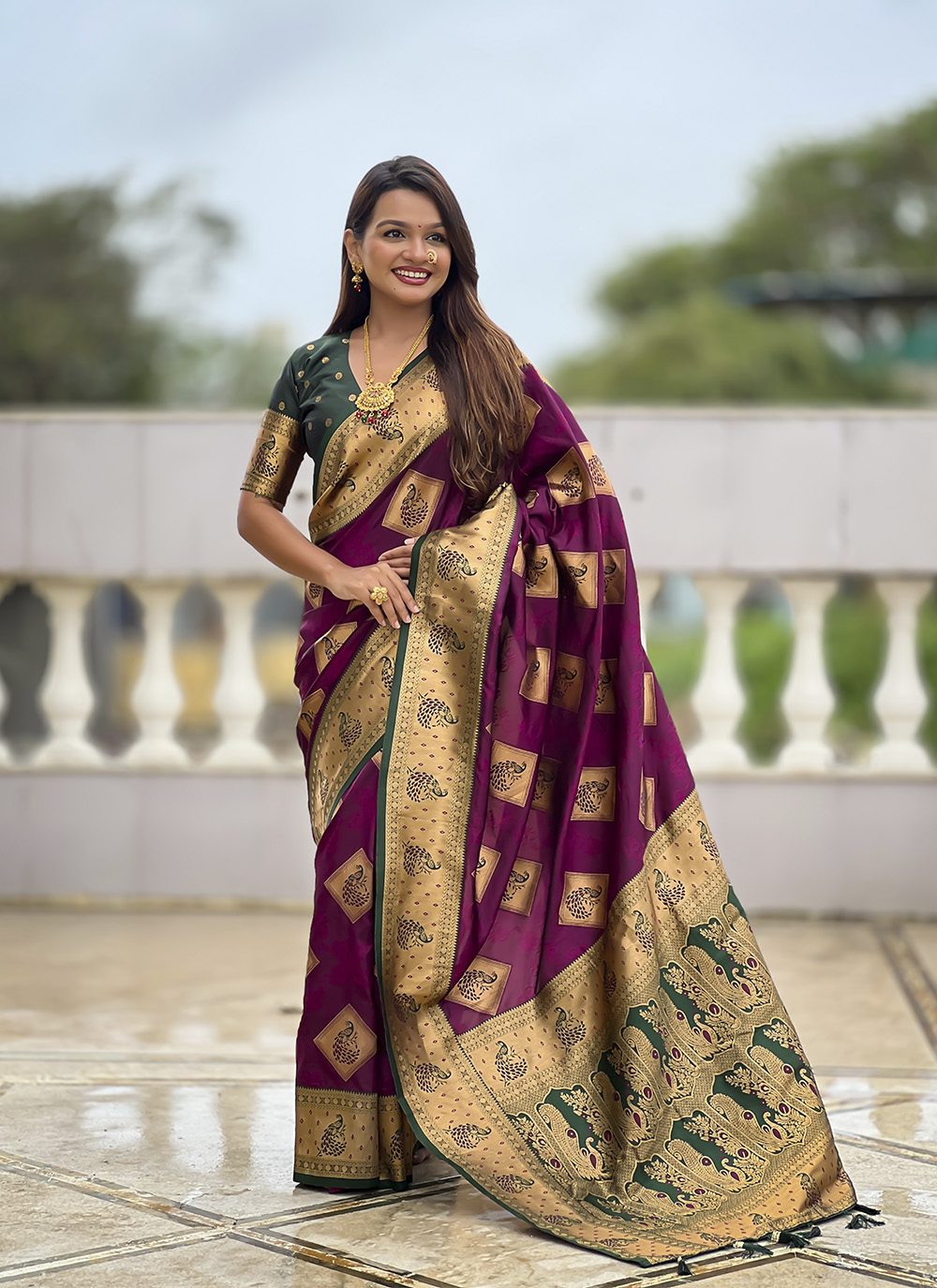
A saree is designed in three zones: body, border and pallu. On the jacquard looms of Surat, extra-weft threads build the motifs in the body, the border runs in a heavier figuring along both selvedges, and the pallu end carries the dense woven artwork that drapes over the shoulder. Getting the three zones to meet cleanly, in register, at consistent tension, is the actual craft of saree weaving Surat style.
Two details surprise buyers. First, the standard running length is 5.5 metres for most North Indian styles, 6.3 metres when a blouse piece is attached in the same length, and up to 9 yards for some South Indian drapes, so the "same design" can be sold in different metreages for different markets. Second, on many fancy lines, two saree lengths are woven as one continuous fabric and separated later at the cutting table, because that is how the loom economics work. The selvedge you check on a delivered saree was woven, not finished afterwards. It should be intact and straight along its full length, and a wobbling selvedge tells you the loom was not watched.
Dye, Print, Finish
Not every saree arrives at its colour the same way. Yarn-dyed sarees get their colour before weaving, which is why their designs hold through every wash: the colour is the thread. Piece-dyed sarees are woven grey and dyed afterwards in the processing houses of Pandesara and Sachin, usually in lots. Printed sarees, an enormous share of Surat output, are woven plain grey, then sent to the print floors, where rotary screens or digital machines lay down body, border and pallu designs that must all land in register on the moving fabric.
Polyester grounds then pass through heat-setting on stenters at high temperature to lock dimensional stability, which is why a decent Surat polyester saree survives washing without distorting. The care point for buyers: check the print registration at the pallu-to-body junction on any printed saree. Misaligned joins are the most common defect of a rushed print run, and they are visible on the rail in your shop.
The Finishing Table: Fall-Pico and Friends
Ask a first-time importer what fall-pico means and you usually get a guess. Here is the real answer. The fall is a narrow inner tape, cotton or poly-cotton, stitched along the lower inner edge of the saree so the drape holds and the hem does not curl. Pico is the knotted picot edging run along the borders so the selvedge edges do not fray with use. Kuchi are the hand-twisted tassels finished onto the loose end. A blouse piece is either attached in the running length or supplied as a separate cut, or the order carries readymade blouses instead.
None of this is decoration; it is the difference between fabric and a wearable garment. On our floor, the finishing table is also a checkpoint. The fall must be stitched without puckering the saree body, and the pico must run the full border without breaks. Finishing is done in small units around the market belt, mostly by women working in organised groups, and during peak wedding season this is the stage most likely to slow your order. Plan for it.
Quality Doors Before the Carton
A saree that will represent you on a rail passes through checks that most buyers never hear about. Inspection happens over a light table, where the fabric is backlit so weaving faults, missed picks, warp breaks and cut zari threads show as shadows. Shade is checked under standardised daylight lamps, because a mismatch that hides under warm showroom lighting embarrasses you in the shop. Weight, length and width are measured against the order sheet, and printed pieces are checked for registration and print defects.
Packing then follows the destination. Volume saree lines pack roughly a hundred folded pieces to an export carton. Boutique programmes pack each saree poly-sleeved with its blouse piece, and premium lines travel with board and tissue supports so the folds arrive crisp. When a buyer tells us their previous supplier's sarees "always arrived creased and tired", it is usually this last stage that was done cheaply.
Frequently Asked Questions
What does fall-pico actually mean?
Fall is the inner tape stitched along the saree's lower edge to stabilise the drape, and pico is the knotted edge finish that stops the borders fraying. Both are standard on Surat sarees unless a buyer specifies otherwise, and both are quality checkpoints in their own right.
How long does one saree take to make?
The weaving of a jacquard fancy saree is a matter of hours on the loom, but the full route, yarn preparation, weaving, processing or printing, finishing and packing, runs days to weeks depending on the queue at each stage. Custom programmes with new designs add punch-card or file development time at the front.
Are Surat sarees handloom?
No. Surat saree manufacturing runs on powerlooms, mostly rapier looms with jacquard heads, which is exactly why the prices structure the way they do and why volumes scale. Handloom sarees come from craft clusters elsewhere, and any supplier claiming handloom status for standard Surat fancy sarees is stretching the truth.
What fabrics are Surat sarees made of?
Mostly man-made fibres: polyester, art silk viscose, georgette, chiffon, crepe, satin and their blends, plus cotton and cotton blends for daily-wear lines. The sarees your customers drape for weddings, parties and daily office wear in the diaspora are overwhelmingly man-made fibre, woven and finished here.
Can I order custom designs or my own colourways?
Yes, through the custom route: your artwork becomes jacquard files or print designs, lab dips or strike-offs approve colour, and a sampling piece approves construction before bulk. Custom adds lead time at the design-development stage, so brief it early rather than at the season deadline.
How are sarees packed for export?
Volume lines fold-pack into export cartons of around a hundred pieces. Boutique programmes poly-sleeve each saree with its blouse piece, and premium lines add board and tissue supports. Tell your supplier how the piece will be sold, on a shelf or straight onto a rail, and packing follows.
Every saree category we run, from daily-wear prints to bridal jacquards, came up through these same stages. If you sell sarees and have never walked a loom shed or a finishing table, we think you would get a lot from it. We host serious buyers on the floor and courier samples ahead of any programme, so message us on WhatsApp with your categories and we will start there.
surat saree manufacturingsaree making processsaree weaving surat
Sourcing ethnic wear for your business?
Our export team shares catalogues, MOQ and pricing tailored to your market — response within one business day.
Delhi designs and Mumbai finances, but the metres themselves are decided in Surat. A look at why one Gujarati city out-manufactures both metros and what that means for your sourcing.
A first-time buyer's walking plan for Surat's market belt, from the Surat Textile Market complex to Ratan Firdous and Bombay Market. Covers how to structure two days, who you are actually talking to in each seat, and the etiquette that gets you treated as trade.