
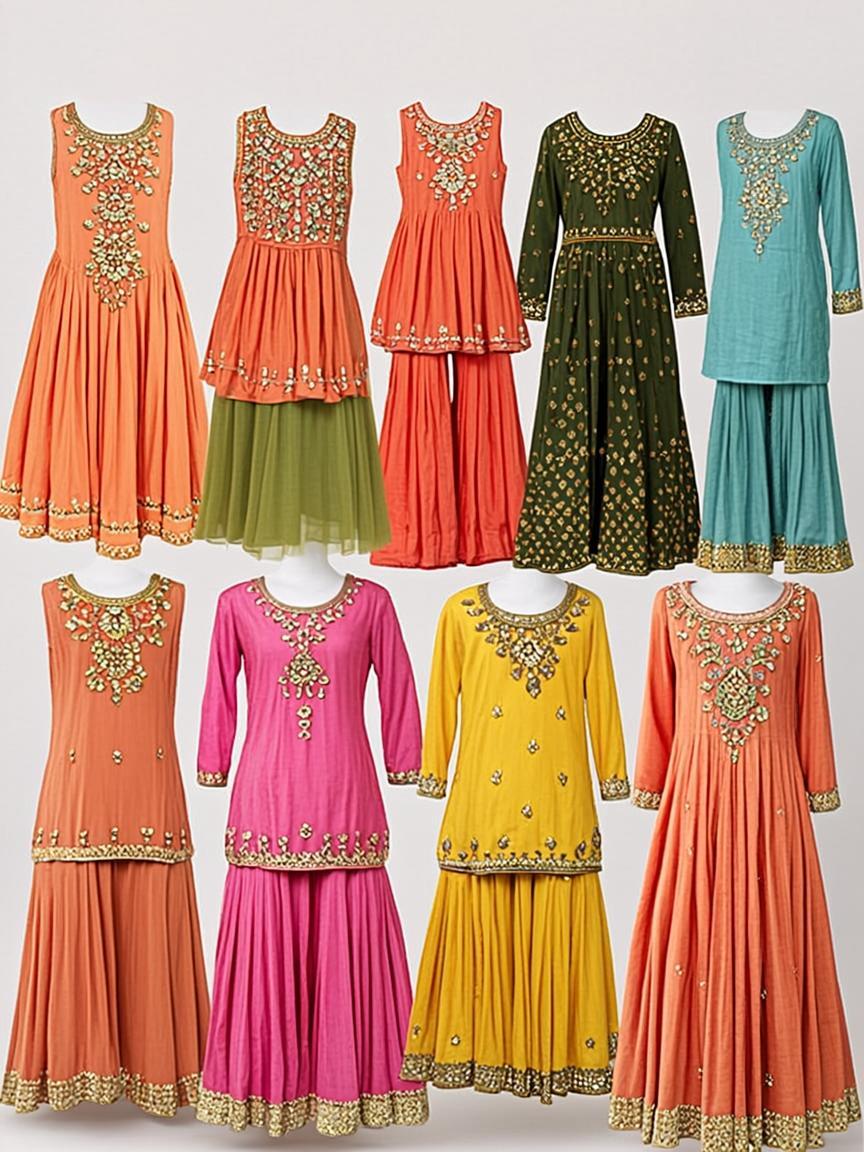
Kids Ethnic Wear Wholesale Supplier in USA — Export from Surat
Kids Ethnic Wear manufactured in Surat and shipped to New Jersey, the New York metro, Chicago, Houston, the Bay Area, Atlanta and Dallas — mixed lots, private label and festival-ready supply windows for USA retailers and boutiques.
Kids ethnic wear is the most under-stocked category in diaspora retail and the easiest to grow — every festival puts every child in the family into new clothes, and shops that stock the category properly own the whole-family shopping trip.
Kurtis, Pakistani suits, bridal lehengas, silk sarees and kids ethnic wear move strongest in the US, with clear spring (April–June) and festive (September–November) buying windows.
What USA buyers order
- Kids lehengas, kurtas and ethnic sets for festival calendars
- Child-safe trims and labelling meeting Western compliance
- Family-event coordination with adult programme colours
- Fast-growing size runs with sensible reorder minimums
Why USA buyers stay with us
- Mixed-lot ordering — sizes, colours and designs combined to reach viable minimums without over-buying any single style
- Festival calendar planning — production slots reserved ahead of USA's diwali, the summer wedding season, navratri and the october festive rush
- Private-label ready — your tags, your packaging inserts, your barcodes
- Photography-friendly finishing — pieces arrive pressed and shelf-ready, cutting your content-creation time
- The US market rewards consistency and legal compliance — buyers there care about labelling accuracy, child-safe trims on kids lines, and a supplier who understands Amazon and Shopify listing photography requirements.
Shipping to USA
Sea freight runs 4–6 weeks via Nhava Sheva to East and West Coast ports; air freight serves launch windows and reorders. We prepare ISF filing data and HS codes with every invoice.
Sizing, grading and private label for USA
Size runs are graded for the market we ship to. We grade our size runs for the market we ship to — USA buyers typically request fuller cuts or extended sizing, and our pattern team adjusts the base grading on confirmed orders.
- Extended and plus-size grading on adjusted patterns, not scaled-up standard charts
- Private-label tags, barcoded labels and packaging inserts applied before dispatch
- Care labels and fibre declarations prepared for USA retail compliance
- Photographed pieces with consistent backgrounds so your listings go up without a reshoot
What a first kids ethnic wear order looks like
The entry path is deliberately low-risk: an enquiry with your quantity range, a video walk-through of current stock and catalogues, then physical samples of the shortlisted pieces. First orders typically run 20–50 pieces per design mixed across sizes and colours for garments, or 500–1,000 metres per shade for fabric programmes — enough to test the shelf without warehousing a season. The buyers who scale fastest treat the first order as a market test: they watch which designs move in the first fortnight, then use our mixed-lot structure to reorder the winners in depth while dropping the slow movers quietly.
Repeat programmes run on reserved capacity. Once a USA buyer confirms a seasonal programme, we hold loom and finishing slots against their calendar, keep their shade standards on file, and dispatch on a schedule their merchandising can plan around — the difference between a supplier who ships and a partner who plans.
Start with an enquiry
Send your wholesale kids ethnic wear for USA requirement across — quantities, shades, widths and the season you are planning for. The desk responds with costing, lead times and the sampling path, because a first order built on verified samples is the only first order we are interested in.
Kids wear collections we manufacture and export
Kids ethnic is an event-driven category that behaves differently from adult wear — bought for Dashain, Eid, Diwali, weddings and school functions, sized for growth, and judged by parents on comfort before ornament. Our programme for USA covers the full range: lehenga choli sets for the wedding-photo shelf, kurta sets and baba suits for the classic look, party wear, ethnic sets, dresses and frocks, plus the daily-wear rotation of shirts, t-shirt sets and bottoms.
Construction discipline is stricter than adult programmes — soft neck finishing, covered elastic where it matters, secure-stitched embellishment instead of glued trim, and higher stitch density because children's seams take real abuse. Fabrics are pre-washed for softness and colourfast-tested for the home-wash reality.
Bulk kids programmes ship size-banded in age grading from 1-13 years, with sibling-set coordination available for the matching-outfit demand that spikes around festival calendars. Retail-ready packing keeps pieces display-face-up for the counter photo that actually moves the category.
- Kids Lehenga Choli — occasion shelf
- Kids Kurta Sets — classic festive look
- Kids Ethnic Sets — baba suits and salwar sets
- Kids Party Wear — function circuit range
- Kids Shirts & T-Shirts — daily rotation
- Kids Dresses & Frocks — boutique tier
Fabrics behind the range
Kids fabrics answer to parents first — softness, safety and wash survival:
Fabric selection is where programme economics are actually decided — the difference between a 90 GSM and a 120 GSM base changes drape, cost structure, shipping weight and the price tier the finished product can hold. Our role is to make that selection explicit rather than accidental: spec sheets with weight, weave, width and finish on every quotation, samples that match the bulk spec exactly, and lot documentation that lets your QC team verify against the same numbers we shipped against.
The clusters behind this programme weave, dye, print, embroider and finish in the same industrial ring — which is why development moves in days and corrections move faster. That proximity is the quiet advantage behind every fabric programme we run.
The Surat advantage — a short history
Surat has been a textile trading city for longer than most trade routes have existed. Mughal-era ships carried the city's silk and cotton to the Persian Gulf and East Africa four centuries ago, and the British port records from the 1600s already describe a loom economy substantial enough to supply entire fleets. When the mill era arrived in the 1900s, Surat's weaving families simply moved from handlooms to powerlooms without letting go of the trading relationships that preceded them by generations.
The modern chapter began in the 1970s and 80s, when the city's mills took the synthetic-fibre revolution and ran with it. Polyester and nylon weaving, dyeing and printing grew into clusters — Ring Road, Sachin GIDC, Palsana — that today produce an outsized share of India's man-made fabric output. A city that once traded cloth now designs, weaves, dyes, prints, embroiders, stitches and exports it, all within a 30-kilometre industrial ring.
For an international buyer, this density is the practical advantage: the mill, the dyeing house, the embroidery unit and the packing floor sit close enough that a quality issue gets solved in a day, not a supply-chain quarter. Our desk works inside that ecosystem, and every page we publish is written from it.
About Ajmera Export — the brand behind this page
Behind this page is a Surat export desk that has spent years learning what international buyers actually get judged on by their own customers. Landed-cost surprises kill retail margins. Late festival arrivals kill a whole season's plan. A shade drift between the sample and the bulk kills trust permanently. Our systems are built backwards from those three failure points.
Ajmera Export consolidates manufacturing and finishing across Surat's clusters into programmes that behave predictably: approved strike-offs before bulk runs, lot-level shade discipline, staged quality inspections with reports that travel with the shipment, and documentation packs that clear customs without follow-up. The desk runs on MOQ structures that let smaller buyers grow into larger ones without renegotiating the relationship each time.
We are a family-trade company in a city where that still means something — the reputation economics of a close-knit merchant community apply. Shortchange a buyer once and three others hear about it at the next trade sit-down. That pressure suits us fine, because the way we work anyway is the way that pressure enforces: honest specs, honest timelines, honest claims handling.
Why businesses choose us
- One accountable desk across weaving, dyeing, printing, embroidery, stitching and packing — no multi-vendor blame chains
- Strike-off approvals before every bulk run, so the shade you sign is the shade that ships
- Lot-level shade and GSM discipline with archived specs on file for every buyer programme
- MOQ structures designed for growing buyers — scale up without renegotiating the relationship
- Private labelling, retail-ready packing and destination-market documentation handled in-house
Start your first order
The practical first step is a sample conversation. Tell us the products or fabric constructions you are evaluating, the volumes you realistically expect to place, and the delivery window you are planning against. We come back with a development plan: what we sample first, what the strike-off timeline looks like, and how the first order can start small enough to be comfortable and still hold production priority.
Every long programme we run today began exactly this way — one enquiry, one sample lot, one clean shipment, then a season calendar. The form on this page or a WhatsApp message both reach the same desk, and both get an answer from someone who can check your question on the production floor the same day.
Frequently Asked Questions
What is the MOQ for wholesale kids ethnic wear for USA?
Most of our kids ethnic wear export orders start at 20–50 pieces per design mixed across sizes and colours. Bridal and premium lines run on smaller MOQs with higher per-piece work, while daily-wear volume programmes need larger commitments for the pricing to work. Send your quantity range and we will structure the order around it.
How long does shipping to USA take?
Sea freight runs 4–6 weeks via Nhava Sheva to East and West Coast ports; air freight serves launch windows and reorders. We prepare ISF filing data and HS codes with every invoice.
Can you handle private label for our USA store?
Yes — private label tagging, custom packaging inserts and barcoded labels are routine for our buyers. Share your label artwork and packaging spec at order confirmation and we handle the rest before dispatch.